You’ve read 50 papers. You KNOW there’s a gap somewhere. But when your supervisor asks “What’s the gap?”... you freeze. 😩
Sound familiar?
If so, this blog is for you!
But before we get into it, a couple of updates ⤵
🇪🇺 I’m Coming to Europe!
I’ve been invited to conduct workshops in Europe and will be there in the first week of March. If your institution is interested in hosting a session or a workshop during that time, request your training here.
Also, I’m expecting cold weather ❄️ so help me out here: where’s the best place to visit during this time? Drop your recommendations in the comments!
📚 SR Workshop → Full Course
My Systematic Review workshop has been converted into a comprehensive course! The promo period has ended, but if you have a genuine need for a discount, just reach out and we’ll work something out.
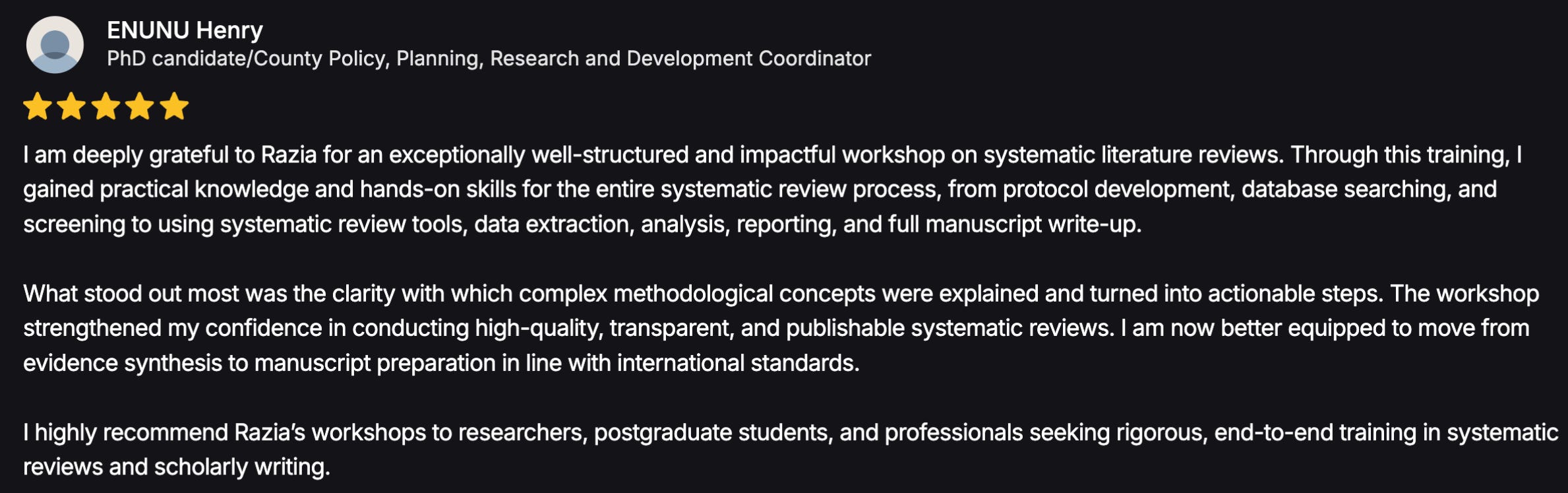
Don’t just take my word for how useful it is, here’s what one participant said:
During my thesis, I spent WEEKS reading papers, highlighting sections, making notes... and still couldn’t articulate the gap clearly. The frustrating part? The gap WAS there. I just didn’t have a systematic way to identify and describe it.
That changed when I discovered a framework from this paper. These researchers developed a method to help systematic review authors explicitly identify and present research gaps. But when I read it, I thought, why limit this to SRs? So, I’ve adapted this framework for everyday use because the logic is universal.
And here’s the thing, this framework becomes even MORE powerful when you combine it with AI tools like Litmaps or ResearchRabbit. These tools help you FIND the papers; the framework helps you ANALYZE the gaps.
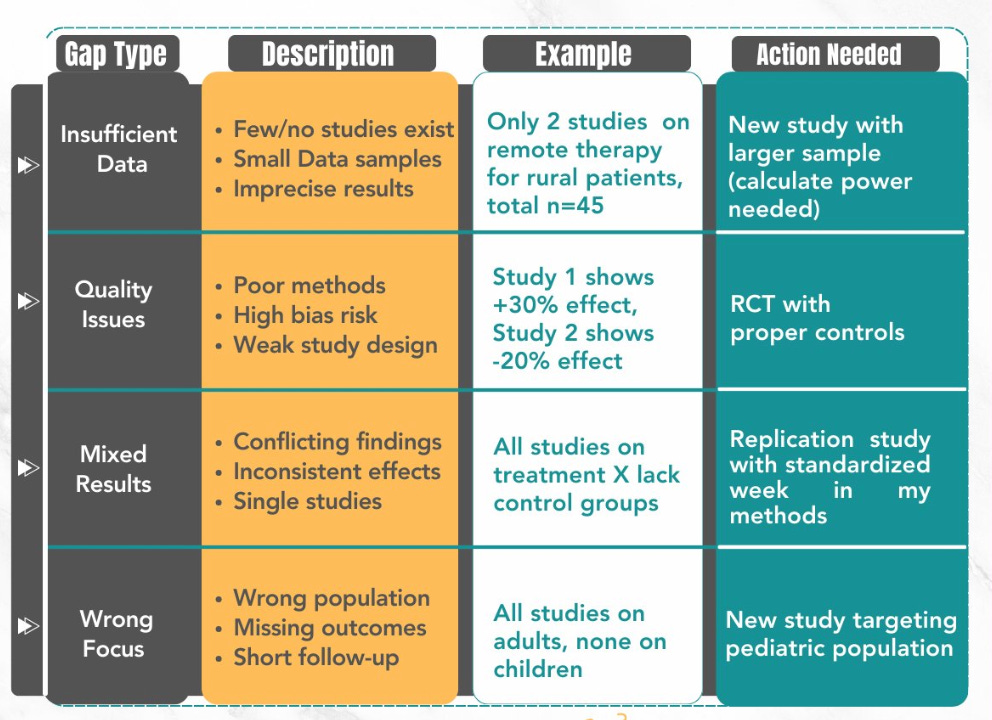
A week before, I turned it into a simple table you can use WHILE reading papers ⤵
If you haven’t already, subscribe for free to receive new insights on AI in research:
The 4 Types of Research Gaps
Here’s what most researchers get wrong: they think a research gap is just “nobody has studied this topic.”
Not quite.
A research gap is when the existing evidence prevents us from drawing conclusions. And there are FOUR distinct reasons why this happens:
1. Insufficient Data
Few or no studies exist on your topic. Or the studies that DO exist have tiny sample sizes (n=12 anyone?). The results are too imprecise to mean anything.
Example: Only 2 studies on remote therapy for rural patients, total n=45
Action: New study with larger sample (calculate power needed)
2. Quality Issues
Studies exist, but they’re poorly designed. High bias risk. Weak methodology. You can’t trust the results.
Example: Study 1 shows +30% effect, Study 2 shows -20% effect due to different methodologies
Action: RCT with proper controls
3. Mixed Results
The findings are all over the place. One study says X works, another says it doesn’t. Single studies without replication. You have no idea what to believe.
Example: All studies on treatment X lack control groups
Action: Replication study with standardized methods
4. Wrong Focus
Studies exist and they’re well-done... but they studied the wrong population, missed important outcomes, or had follow-up periods too short to matter.
Example: All studies on adults, none on children
Action: New study targeting pediatric population
How I Use This Table
Here’s my process ⤵
Step 1: Pick the row that best matches your gap
Step 2: Check - does your gap fit multiple types? (That’s normal!)
Step 3: Use the example format to describe YOUR gap specifically
Step 4: Use the “Action” column to outline your next steps
Fill this out WHILE reading papers, not after. Your future self will thank you!
I promised you a complete framework with a workbook this week.
📎 Here it is: a fillable worksheet based on the Robinson et al. framework that helps you:
Identify WHERE the gap exists (Population, Intervention, Comparison, Outcomes, Setting)
Classify WHY the gap exists (which of the 4 types)
Document specific examples from papers you’ve read
Plan your research approach
I’ve adapted the original academic framework into something actually usable during your literature review.
Bonus: AI-Powered Gap Analysis
Want to speed this up? Here’s a prompt to try with Claude or ChatGPT or Gemini after reading a paper:
“Based on this paper’s methodology and findings, identify potential research gaps using these categories: (1) insufficient data, (2) quality issues, (3) mixed/inconsistent results, (4) wrong focus (population, outcomes, or setting). Be specific about what’s missing.”
The AI won’t replace your critical thinking, but it CAN help you spot patterns you might miss after reading 30+ papers. I use it as a “second pair of eyes” before finalizing my gap analysis.
One More Thing
As mentioned, the original framework was designed for systematic reviews, but I’ve found it works brilliantly for ANY lit review. PhD students, Masters researchers, even undergrads working on their thesis - this gives you the language to articulate gaps clearly.
Your supervisor asks “What’s the gap?” and now you can say:
“The existing evidence on [topic] has INSUFFICIENT DATA because only 3 studies exist with a combined sample of 89 participants. We need a larger study with adequate power to detect the effect.”
See the difference? 🙌
📚 Reference
Robinson KA, Saldanha IJ, McKoy NA. Development of a framework to identify research gaps from systematic reviews. Journal of Clinical Epidemiology. 2011;64(12):1325-1330.
Learned something new in this newsletter?
🔁 Like and Share
If you want me to address your question in the next newsletter, send in your question either by clicking ‘reply’ or commenting on the post ⤵
See you soon! 😄
Razia
Thanks for reading Era of the Research Bots 🤖 Subscribe for free to receive new posts and support my work.


So insightful
Thanks so much